A Guide to Korean Pantry Staples
One Korean Jar That's Older Than America
Somewhere in Korea, there is a jar of soy sauce older than the United States.
Some Korean families keep homemade soup soy sauce that is more than 400 years old, brought out and ladled out for special occasions.
In Korea, soy sauce isn't one thing. It's a small family of bottles, and each one has a job for specific purposes.
Meet the different kinds of Korean soy sauce, learn what each one does, and find out which bottle belongs in your kitchen.
Your
Ganjang
Start Here
The Quick Guide
Ganjang (gahn-jahng) is the Korean word for soy sauce. Here's a quick guide to which bottle to grab:
Know Your Bottles
Three Bottles, Three Jobs
Not sure which one to reach for? Use this as your cheat sheet.
| Bottle | Its Job | Sempio Pick |
|---|---|---|
| Guk-ganjang (soup soy sauce) |
The one that seasons without staining: clear soups, namul. | Sempio Soup Soy Sauce |
| Yangjo-ganjang (brewed) |
The one you taste: dips, dressings, quick stir-fries. | Soy Sauce 501 or 701 |
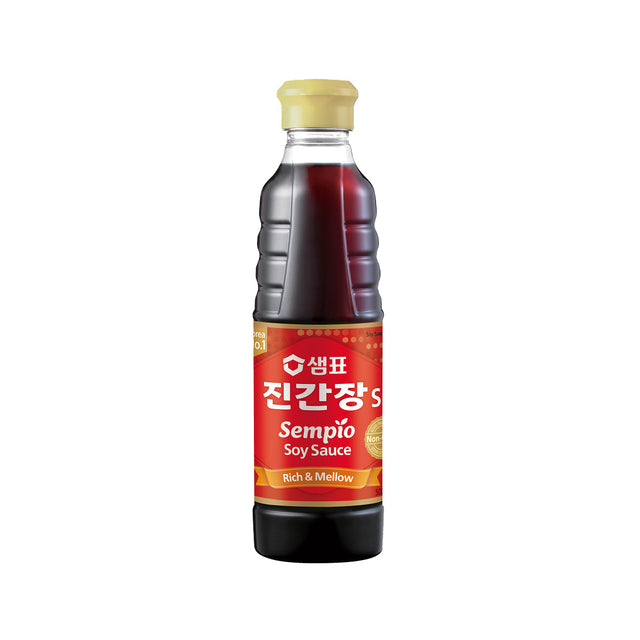
| Jin-ganjang | The one that cooks: braises, marinades, high heat. | Jin S, Jin Gold F3 |
| No Soy Sauce | The one everyone can eat: a 1:1 swap for any of the above. | No Soy Sauce |
01 / The Everyday Bottle
The Bottle You Probably Already Own
If there's a bottle of naturally brewed soy sauce in your fridge right now, that's the closest thing to yangjo-ganjang.
Yangjo-ganjang is brewed slowly from soybeans and wheat, and it has the fullest aroma of the family. That's why it shines where you taste it straight-up and use it as a condiment: as a dumpling dip, a drizzle over rice, a salad dressing, or in a quick stir-fry that's done in five minutes.
Meet Sempio 501 & 701
Sempio Soy Sauce 501 and 701 are naturally brewed for six months.
02 / The Workhorse
Jin-Ganjang: The Soy Sauce That Loves Heat
If yangjo-ganjang is the soy sauce you use as a condiment ("raw"), jin-ganjang is the one that does great with heat. It's made to hold its flavor under heat, so it's the bottle Korean home cooks reach for when soy sauce is going to simmer, sear, or caramelize.
Think braised short ribs, soy-glazed chicken, bulgogi, or noodles tossed in a hot pan.
Here are some that Sempio makes:
- Jin S: Rich and mellow, with a subtle sweetness. Our everyday bottle.
- Jin Gold F3: Higher in nitrogen, for deeper, more complex flavor when soy sauce is the star.
Braising Tip
Add 75% of the amount your recipe calls for at the start, and hold any extra until the end. As the liquid simmers down, it gets saltier on its own.
03 / The Lightest Bottle
Did You Know? The Lightest Bottle Is the Saltiest!
Guk-ganjang, or soup soy sauce, is pale amber and much lighter in color than regular soy sauce. It looks gentle, but it's actually saltier than the others, so a small splash goes a long way.
Korean soups like seaweed soup and radish soup are meant to stay clear and bright. Soup soy sauce is a key bottle in the Korean pantry because its job is to season broths without turning them brown.
How to use it: Add a little near the end, stir, and taste.
A Little Korean Food History
Fun Fact: Soup Soy Sauce and Doenjang Are Siblings
They come from the same fermentation crock (onggi/hangari). In traditional Korean jang-making, blocks of fermented soybeans soak in salt water for months. The solids become doenjang, Korea's fermented soybean paste. The liquid becomes soup soy sauce.
Meet the other sibling in our guide to doenjang.
Try This at Home
The Two-Bowl Test
Want to see the difference for yourself? Try this simple side-by-side experiment.
An Alternative for Everyone
Cooking for Everyone? Meet No Soy Sauce
Got a friend with a soy or wheat allergy? Sempio No Soy Sauce is made from peas instead of soybeans. It's free of the top 9 major allergens, gluten-free, and vegan, and it tastes like traditional soy sauce.
A Simple 1:1 Swap
Swap it 1:1 in any recipe, and the whole table eats the same dish.
FAQs
Questions We Hear a Lot
Do I really need all of them?
No. Start with one good brewed soy sauce, like 501, and use it everywhere. Add jin-ganjang when you start braising and soup soy sauce when you start making Korean soups.
Is Korean soy sauce gluten-free?
Usually not, because most soy sauce is brewed with wheat. Sempio 501, Jin S, and Jin Gold F3 all contain wheat and soy. For gluten-free, reach for No Soy Sauce, and see our gluten-free Korean sauces guide.
Can I use regular soy sauce in Korean soup?
You can. Just use less, expect a darker broth, and finish with salt.
Case Closed
So, About That 400-Year-Old Jar...
You don't need centuries to cook like a Korean grandmother. You just need to know which bottle does which job. Pick the one that matches the dish you make most, try it this week, and let it earn its spot on your shelf.